On June 8, 2026, Meta made one of the biggest workforce announcements in recent memory: a $115 million first-year investment to launch America’s Workforce Academy, a program designed to fast-track thousands of people into skilled trades careers, building the data centers that power artificial intelligence. If you have been wondering whether the trades are a real path forward, this news should settle the question. The data center industry is hiring at a pace we have not seen in a generation, and California sits at the center of the action.
This article breaks down what data center construction jobs look like, who they are for, what they pay, and how you can get started in California today without taking on a dollar of student debt.
Key Takeaways
- On June 8, 2026, Meta launched America’s Workforce Academy with a $115 million first-year investment, partnering with the Associated Builders and Contractors, CBRE, and the National Urban League. Participants are paid while they learn, owe nothing for training, and every graduate receives a guaranteed job offer plus portable industry credentials.
- AWA’s 2026 pilot hubs are in Louisiana, Ohio, Indiana, and Texas – not California. But the same earn-while-you-learn, debt-free pathways already exist in California through ABC Southern California and Trades For All, including Trade School, Craft Trainee programs, and state-registered apprenticeships.
- AI and cloud data centers are fueling record demand. The U.S. construction industry needs roughly 349,000 new workers in 2026, and data center construction is a leading driver. California alone accounts for more than 81,000 AI-infrastructure and data center jobs.
- Entry-level data center construction work requires no prior experience. You start as a helper or trainee, earn a paycheck from day one, and can progress to journeyman status and eventually supervisory or data center construction manager roles within three to seven years.
- Your next step: visit TradesForAll.org to explore California trade career paths, take a career quiz, and connect with ABC SoCal programs to start building the infrastructure that powers America’s future.

America’s Workforce Academy: A New Model for Skilled Trades Training
Something historic happened on June 8, 2026. Meta announced America’s Workforce Academy – a program being described as the largest private-sector commitment to skilled trades with a job guarantee in American history. For anyone who has been watching data center construction jobs multiply and wondering how to break in, this is the loudest signal yet that the industry wants you.
Here is how the model works in plain language. Meta is investing $115 million in the first year alone to fund a nationwide, fast-track training program. The focus: building the workforce needed to construct and maintain AI-era data centers and the supporting infrastructure. Meta does not run the training itself. It partners with organizations that already know how to do this well, including the Associated Builders and Contractors (ABC) for contractor engagement and credentialing, CBRE for hands-on training and deployment to live data center projects, and the National Urban League, along with groups like the U.S. Hispanic Chamber of Commerce and STRIVE, to reach underrepresented communities.
What makes this remarkable for participants:
- Training costs you nothing. Tuition, travel, and lodging are covered by the program.
- You get paid to learn. Every participant receives a stipend during training.
- Every graduate gets a guaranteed job offer in a skilled trade role needed on data center projects.
- You leave with portable credentials. Graduates earn both a nationally recognized NCCER credential and an America’s Workforce Certificate, which travel with you across employers in the construction and data center sectors.
This is not Meta’s first move. Its earlier Level-Up fiber-technician program – a free, four-week course – drew 35,000 applications in its first seven days. That number tells you something important: tens of thousands of people are actively looking for an alternative to a four-year degree, and they want careers where they can earn while they learn.
AWA’s 2026 pilot training hubs are launching in four states: Louisiana, Ohio, Indiana, and Texas. If you live in California, you cannot enroll in an AWA training center locally today. But do not let that discourage you. The model that Meta is celebrating – paid training, zero tuition, real credentials, direct connection to employer demand – already exists in California. And California’s data center boom is arguably even bigger.
The program is designed for:
- Career changers looking for stable, high-paying work
- Recent high school graduates weighing alternatives to college
- Veterans transitioning out of military service
- Returning citizens seeking structure and a fresh start
- Women exploring the skilled trades
Why Data Center Construction Jobs Are Booming Right Now
Every time you ask a voice assistant a question, stream a movie, or watch an AI tool generate an answer, you are relying on a physical building somewhere – a data center. These facilities house the servers, storage, and networking equipment that make the digital world run. And the new wave of AI is driving demand for data center capacity to levels no one predicted five years ago.
Think of it this way. Training a single large AI model can require thousands of specialized processors running for months inside a facility that consumes as much electricity as a small city. Multiply that across every major tech company racing to build AI products, and you start to understand why hyperscale data centers are being planned and constructed at a pace that has the entire construction industry scrambling for workers.
The numbers back this up. The Associated Builders and Contractors reports that the U.S. construction industry must attract approximately 349,000 new workers in 2026 to meet demand, and that data center construction is a leading contributor to contractor backlogs and rising builder confidence. According to Visual Capitalist, there were roughly 482,716 jobs nationally in AI-infrastructure and data center roles in 2025, with California leading all states at approximately 81,577 positions – about 17 percent of the national total.
Major hubs are growing in regions such as northern Virginia, the San Francisco Bay Area, parts of Texas, and the Pacific Northwest. But the demand is national and continues to accelerate.
What a modern data center actually requires
A hyperscale data center is not a simple warehouse with some servers inside. It is a mission-critical facilities project that blends heavy commercial construction with extreme precision. Building one requires:
- Massive concrete and steel shells engineered to support enormous floor loads and withstand seismic, wind, and weather events.
- Complex electrical systems, including switchgear, transformers, power distribution equipment, generators, and UPS systems that ensure uninterrupted power even during outages.
- Cooling infrastructure with chillers, air handlers, containment systems, and mechanical systems designed to remove heat from thousands of running servers.
- Fiber-optic and copper network infrastructure connecting every rack, room, and building through structured cabling systems that must be installed with precision.
- Plumbing for chilled water, condensate, and fire suppression, feeding the cooling and safety systems that keep the data center environment stable.
The four trades that data centers rely on most map directly to these scopes:
- Electricians – installing and maintaining switchgear, transformers, power distribution units, generators, and emergency power systems. Electrical work on a data center site demands tight tolerances and strict safety protocols.
- Low voltage technicians – pulling fiber-optic and copper cables, building network rooms, installing structured cabling and controls for security, monitoring, and data systems. This is where network engineers and design teams depend on precise field execution.
- Plumbers and pipefitters – installing chilled-water lines, condensate drains, and process piping that support cooling and fire suppression systems throughout data center facilities.
- Sheet metal and HVAC workers – fabricating and installing ductwork, air handlers, rooftop units, containment systems, and high-efficiency cooling equipment critical to mechanical engineering performance.
Data center construction blends traditional commercial construction with highly technical, tightly scheduled work. Projects often run for two or more years, creating stable employment for the trades involved. And because every hyperscale campus typically plans multiple phases of expansion, a single site can provide work for years – or even decades – of center construction activity. Supply chain coordination, cost control, and working with third-party vendors are constant, and the demand for construction management professionals and skilled tradespeople shows no signs of slowing.
America’s Workforce Academy is explicitly designed to feed this demand by training electricians, welders, plumbers, HVAC workers, fiber technicians, and other tradespeople for data center projects. But the opportunity extends well beyond any single program.

From No Experience to Data Center Construction: What Entry‑Level Work Looks Like
Let us be clear about something: you do not need prior tech or construction experience to get started in data center construction. You need a willingness to learn, the discipline to show up on time, and a commitment to working safely. That is the baseline. Everything else gets taught on the job and in the classroom.
Here is what your first year might look like depending on the trade you choose:
- Electrical helper: You carry materials, assist licensed electricians with basic conduit installation, label circuits, and start learning to read engineering drawings. Over time, you handle more complex electrical work under supervision and begin understanding construction documents for power systems.
- Low-voltage installer trainee: You pull and dress cable, install cable trays and J-hooks, and terminate simple connections under supervision. You learn how structured cabling fits into the bigger picture of data center design and network infrastructure.
- HVAC and sheet metal helper: You assist in fabricating and hanging ductwork, setting equipment pads, and supporting commissioning tasks on mechanical systems. You learn about the relationship between airflow, cooling, and server performance in data center environments.
- Plumbing and pipefitting helper: You measure and cut pipe, set hangers, and support the installation of chilled water and drain systems. Precision matters – a leak in a data center is not just a plumbing problem; it threatens millions of dollars of equipment.
The day-to-day reality
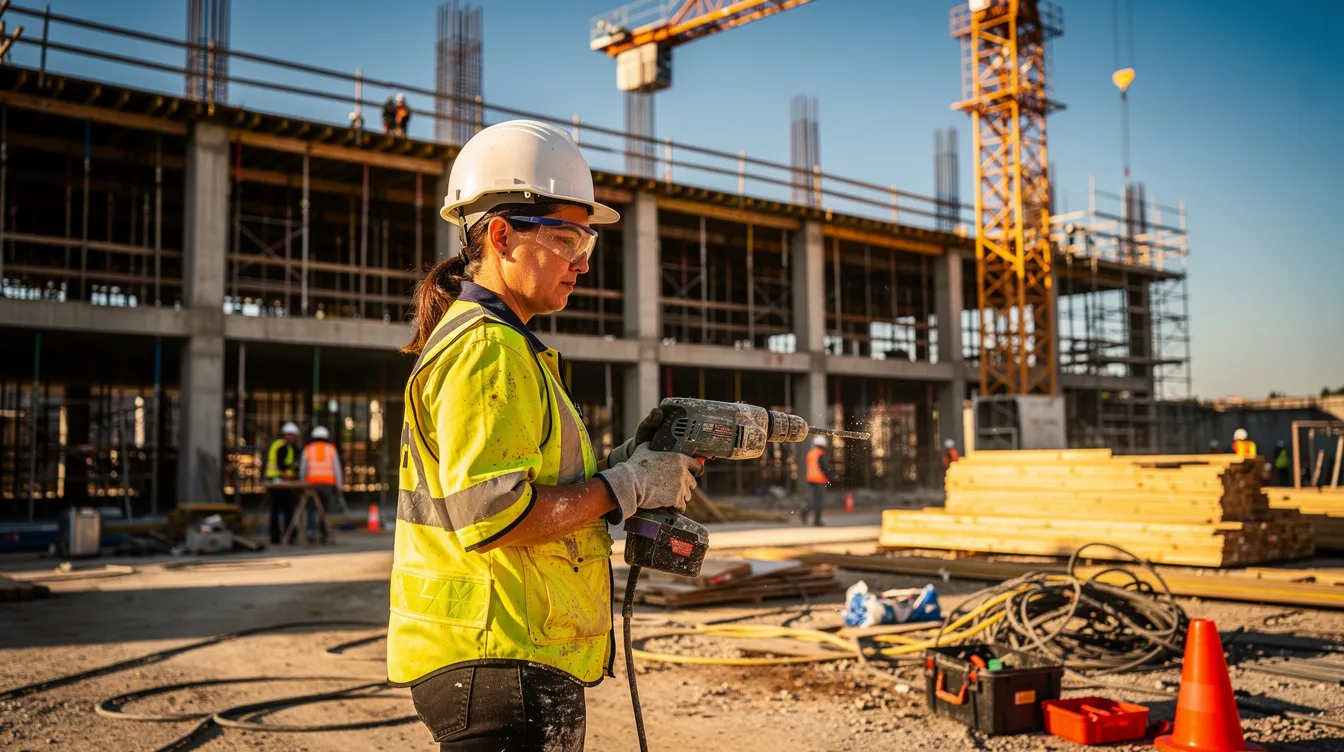
Expect early start times, often around 6 or 7 a.m. You will work eight- to ten-hour days and wear PPE, including hard hats, safety glasses, gloves, and steel-toed boots. Daily safety briefings are standard before each shift. You will work as part of a tight crew on a single large site, sometimes for months or years. Some tasks involve frequent climbing on ladders and scaffolding. The work is physical but purposeful – every conduit you pull, every duct you hang, has a direct impact on whether the facility can go online.
What matters more than experience
At this stage, the skills that set you apart have less to do with technical knowledge and more to do with character:
- Reliability and punctuality – showing up ready to work every day
- Willingness to learn hand tools and power tools safely
- Basic math and measurement (fractions, tape measure, angles)
- Ability to read simple drawings and follow instructions
- Excellent communication skills – being able to listen to a foreman, ask questions, and work with a crew
Over three to five years, entry-level workers grow into advanced data center roles:
- Journeyman electrician or low voltage technician leading small crews and handling complex installations independently. At the journeyman level in California, median wages are approximately $76,540 for electricians and $79,630 for sheet metal workers, with specialized data center work often commanding higher wages.
- Data center technician focusing on startup, testing, commissioning, or ongoing maintenance of critical systems. These roles involve daily operations such as monitoring equipment performance, conducting root cause analysis when issues arise, and ensuring the timely resolution of any faults.
- Data center construction manager or foreman coordinating multiple trades, managing materials and schedules, and working to monitor construction progress on large center construction jobs. This role demands the ability to manage teams and a thorough understanding of safety procedures, construction progress tracking, and coordination with external stakeholders.
Many data center contractors prefer to promote from within. Someone starting as a helper in their early twenties – or making a mid-career switch – can reasonably target six-figure earnings in supervisory roles after gaining experience and credentials. That kind of career growth is hard to match in most fields that do not require a bachelor’s degree.

California’s Pathways Into Data Center Construction (Trade School, Craft Trainee, Apprenticeships)
America’s Workforce Academy is grabbing headlines, and it deserves the attention. But here is the empowering takeaway for anyone in California: you do not have to wait for a national pilot program to land in your state. The same earn-while-you-learn, no-tuition model already exists right here through ABC Southern California and the Trades For All initiative.
What is Trades For All?
Trades For All is a California nonprofit initiative powered by ABC Southern California’s ERiCA grant – the Equal Representation in Construction Apprenticeship program funded by the California Division of Apprenticeship Standards. Its mission is to open doors into construction trades for high school students, career changers, veterans, women, and returning citizens. Through TradesForAll.org, you can explore trade careers, see success stories from real California workers, and connect directly with training programs.
Three pathways that mirror the AWA model
| Pathway | What It Is | How It Works | Time to Complete |
|---|---|---|---|
| ABC SoCal Trade School | Classroom and lab-based technical training | Structured curriculum in Electrical, Low Voltage, Plumbing, or Sheet Metal/HVAC; no college debt | Varies by trade |
| Craft Trainee Program | Part-time, work-friendly training | For people already working or preparing to work in construction; classes align with business needs of data center contractors | Ongoing, flexible |
| State-Registered Apprenticeship | Full-time paid employment plus related instruction | Work for a contractor, earn a paycheck from day one, attend classes, and progress through wage steps | ~3 to 5 years depending on trade (Electrical ~8,000 OJT hours; Plumbing ~7,200; Sheet Metal/HVAC ~6,500; Low Voltage ~4,800) |
These California pathways share the advantages that make AWA so appealing:
- No traditional student debt. Training is employer-funded, state-funded, or heavily subsidized. You do not take out loans.
- On-the-job training with real wages. You earn while you learn, and your pay increases as your technical skills grow – typically stepping up every 600 to 800 hours of documented work.
- Portable credentials. Your state-registered journeyman card and experience travel with you across contractors and data center projects statewide.
- Dedicated support for underrepresented workers. The ERiCA initiative, which funds Trades For All outreach, provides mentorship, childcare support, and inclusive culture programming for women, veterans, returning citizens, and others.
California is scaling up fast
In April 2026, Governor Newsom announced expanded apprenticeship and workforce training programs that will reach over 60,000 Californians, with $37.2 million in new funding supporting more than 55,000 apprentices in the building and construction trades. The state has set an ambitious goal of adding roughly 500,000 new apprentices by 2029. That means new funding, more pre-apprenticeship slots, and stronger employer partnerships are ramping up in ways that favor new entrants.
Data center contractors in California – serving cloud providers, AI labs, and enterprise operations – already depend on ABC-trained electricians, low voltage specialists, plumbers, and HVAC/sheet metal workers. These programs tie directly to real job sites, not just classroom theory.
What your first 90 days could look like
- Visit TradesForAll.org and take the career quiz to identify which trade fits your interests
- Gather your documents: high school diploma or GED, transcripts showing algebra, driver’s license, Social Security card
- Attend an ABC SoCal info session or contact them about the next intake for Trade School, Craft Trainee, or apprenticeship
- Ask about ERiCA-supported services – childcare assistance, mentorship, and financial support during training
- Pass the entrance assessment (typically a TABE test covering basic math and reading)
- Begin your first on-the-job training hours with a sponsoring contractor, potentially on a data center project
The smooth transition from classroom to jobsite is built into the program design. Many participants begin earning within weeks of enrollment.
Who Thrives in Data Center Construction: Diverse Paths, One Opportunity
Data center construction is not reserved for one type of person. It is an opportunity for anyone willing to learn a trade, work with their hands, and show up consistently. The data center industry values reliability, safety awareness, and problem-solving ability far more than pedigree.
Here is how different paths lead to the same destination:
- High school graduates and young adults (18–22): You can start a career with no college debt, learning mechanical and electrical skills that last a lifetime. While your peers take on student loans, you earn a paycheck and build toward professional growth in a field where an associate’s degree or bachelor’s degree is optional for most roles. Some may choose to pursue further education in civil, electrical, mechanical, or computer science later, but the trades give you a foundation and income first.
- Career changers in their 20s, 30s, and 40s: Skills from logistics, hospitality, retail, or IT transfer well to data center work. If you have managed teams, solved problems under pressure, or coordinated schedules, you already have preferred qualifications and experience that contractors value. Field coordination, data center technician roles, and construction management positions all benefit from people who understand customer service, teamwork, and the ability to keep projects moving in a timely manner.
- Women exploring the trades: The number of women electricians, welders, and technicians on data center projects is growing. The ERiCA initiative specifically focuses on equity, mentorship, and creating safe, respectful job sites. An inclusive culture is not just an aspiration – it is backed by state funding and active programming. Regardless of sexual orientation, marital status, or background, these programs are designed to welcome qualified applicants.
- Veterans: Military experience with systems, discipline, safety requirements, and leadership maps naturally to data center facilities work. Veterans often excel in roles requiring attention to safety protocols, reading technical manuals, and supervising crews. Many programs recognize protected veteran status and offer accelerated pathways based on prior military training. Programs function as an equal opportunity employer regardless of national origin or background.
- Returning citizens (formerly incarcerated individuals): California programs linked to Trades For All are intentionally designed to offer second-chance pathways with real wages, structure, and employee development support. If you are looking for work that values what you can do – not just where you have been – data center construction offers that opportunity. Many contractors provide reasonable accommodation and focus on hiring based on capability and commitment.
Moving from field to leadership
For readers interested in leadership, the path from helper to data center construction manager is well-worn. You start as a helper or first-year apprentice, complete your state-registered apprenticeship, gain experience across multiple data center projects, and then step into foreman, superintendent, or construction manager roles.
A construction manager on a data center project plays a key role in coordinating trades, reading plans, tracking schedules, managing cost control, and ensuring that complex projects finish on time and safely. This work involves communicating with a general contractor, coordinating with network engineers and design teams, reviewing construction documents and engineering drawings, and reporting to external stakeholders. It also demands strong team management skills and a commitment to employee development within your crew.
Realistic earning expectations over time look something like this:
| Career Stage | Approximate Annual Earnings (California) |
|---|---|
| Helper / 1st-year apprentice | $38,000 – $50,000 |
| Mid-level apprentice | $50,000 – $65,000 |
| Journeyman (Electrical) | ~$76,540 median |
| Journeyman (Sheet Metal) | ~$79,630 median |
| Supervisor / Foreman | $90,000 – $120,000+ |
| Construction Manager | $110,000 – $150,000+ |
Many employers also offer additional benefits, including health insurance, dental, 401 k retirement plans, and, in some cases, relocation assistance. Some larger contractors provide tuition reimbursement for continuing education in a related field.
The hiring process at most contractors focuses on your willingness to learn, your safety record, and your reliability – not your resume or GPA.

How to Start Your Data Center Construction Career in California Today
You have read about the national movement, the numbers, the trades, and the career paths. Now it is time to act. If you are in California and interested in data center construction jobs, here is exactly what you can do this week.
Step 1: Explore at TradesForAll.org. Visit TradesForAll.org to learn about construction careers, understand what data center work involves, and read real success stories from California workers who started where you are now.
Step 2: Take the career quiz. Use the Trades For All career quiz to identify which trade – Electrical, Low Voltage, Plumbing, Sheet Metal/HVAC, or another path – best matches your interests and strengths. This takes a few minutes and gives you a starting point.
Step 3: Connect with ABC Southern California. Reach out to ABC SoCal to learn about their Trade School, Craft Trainee program, and state-registered apprenticeships. Ask about upcoming enrollment windows, preferred qualifications, and what the hiring process looks like for your chosen trade.
Step 4: Prepare your application. Gather your high school diploma or GED, transcripts showing algebra completion, driver’s license, and Social Security card. If you need to brush up on basic math, there are free resources online. If childcare or transportation is a concern, ask about ERiCA-supported services.
Step 5: Show up and build. Once accepted, commit to being on time, learning safety practices, and taking pride in building data center facilities that power AI, cloud services, and the apps millions of people use every day. Your daily operations on a data center site – whether pulling cable, bending conduit, or hanging duct – have a direct impact on whether a facility comes online safely and on schedule.
In California, you can train for data center construction jobs without taking on student debt, while earning a paycheck and building a portable career in an industry that needs you.
The data centers powering America’s AI future need to be built by someone. That someone can be you. You are not just a job seeker – you are part of the workforce building and maintaining the infrastructure behind everything the digital economy runs on. If you Google “continue my education without debt” or “careers without college,” the trades should be at the top of your list.
Start today. Visit TradesForAll.org, find your trade, and take the first step toward a career with real industry standards, real pay, and real professional growth.

FAQ: Data Center Construction Careers in California
Do I need a college degree to work on data center construction projects?
No. A four-year bachelor’s degree is not required for most data center construction roles, including electrician, low-voltage technician, plumber, HVAC/sheet metal worker, and data center technician. These careers are built through trade school, craft training, and state-registered apprenticeships – not university classrooms.
Some higher-level roles – like positions in data center design, certain mechanical engineering or electrical engineering specialties, or civil engineering management – may list a degree among their preferred qualifications. Some employers note that an associate’s degree in a related field or equivalent experience is acceptable. But the vast majority of field, installation, and technician positions do not require a degree at all.
If you are unsure about going to college, explore trade pathways first. You can always pursue further education later – and many apprentices do, using tuition reimbursement from their employers.
Can I enroll in America’s Workforce Academy if I live in California?
As of 2026, America’s Workforce Academy pilot training hubs are located in Louisiana, Ohio, Indiana, and Texas. There is not yet a California training site where you can attend in person, specifically under the AWA program.
However, some parts of the program may accept applicants from any state, particularly for roles that require travel to project sites. If you want local, in-person training without relocating, California offers immediate alternatives through ABC Southern California’s Trade School, Craft Trainee, and apprenticeship programs. These deliver similar paid, no-tuition training pathways with portable credentials.
Use AWA as inspiration and proof of concept – it shows that the industry is investing heavily in people just like you. Then focus on the California programs at TradesForAll.org that are enrolling now.
What does a typical work schedule look like on a data center construction site?
Most data center construction sites operate with early morning start times, typically around 6:00 or 7:00 a.m. Standard shifts run eight to ten hours, Monday through Friday. During critical phases of data center projects – particularly when systems are being commissioned, or deadlines are approaching – Saturday work and overtime are common.
Schedules vary by contractor, project stage, and trade. Electrical and low-voltage crews may work different shifts from mechanical or plumbing crews, depending on construction progress and the sequencing plan. Reliable transportation is essential, especially for apprentices and new helpers building a reputation. Punctuality is non-negotiable on mission-critical facilities where delays cascade across every other trade on site.
How long does it take to go from entry‑level to a journeyman in the trades used in data centers?
Most California state-registered apprenticeships take roughly three to five years to complete, depending on the trade:
- Electrical: approximately 8,000 on-the-job training hours (about 4.5 years)
- Plumbing: approximately 7,200 hours
- Sheet Metal / HVAC: approximately 6,500 hours
- Low Voltage (Electronic Systems Technician): approximately 4,800 hours
During this time, you work full-time on sites, including data center facilities, while attending related instruction. Your pay increases as you progress through the program’s levels. After reaching journeyman status, you can pursue specialized data center training, move into foreman or superintendent roles, or work toward becoming a data center construction manager with additional experience and team management skills.
Is data center construction safe, and what kind of safety training will I receive?
Safety is a top priority on every data center construction project because of the high-energy electrical systems, heavy equipment, complex mechanical systems, and tight working conditions involved. Contractors take safety requirements seriously – a single incident can shut down an entire project.
As a new worker or apprentice, you will receive a safety orientation before stepping onto any job site. This includes training in PPE use, fall-protection basics (data center work often involves frequent climbing on ladders and scaffolding), lockout/tagout concepts for electrical systems, hazard recognition, and emergency procedures. Most sites conduct daily safety briefings before each shift where crews review the day’s hazards and safety protocols.
ABC Southern California programs and their ERiCA-supported initiatives emphasize a culture of safety and ongoing training, helping you build a long career without unnecessary risk. If you need a reasonable accommodation related to any physical or other limitation, contractors are required to work with you to provide it. The goal across the data center industry is simple: everyone goes home safe at the end of every shift. If an issue arises on site, crews are trained to perform root cause analysis and reach a timely resolution before work resumes – protecting both people and the facility.