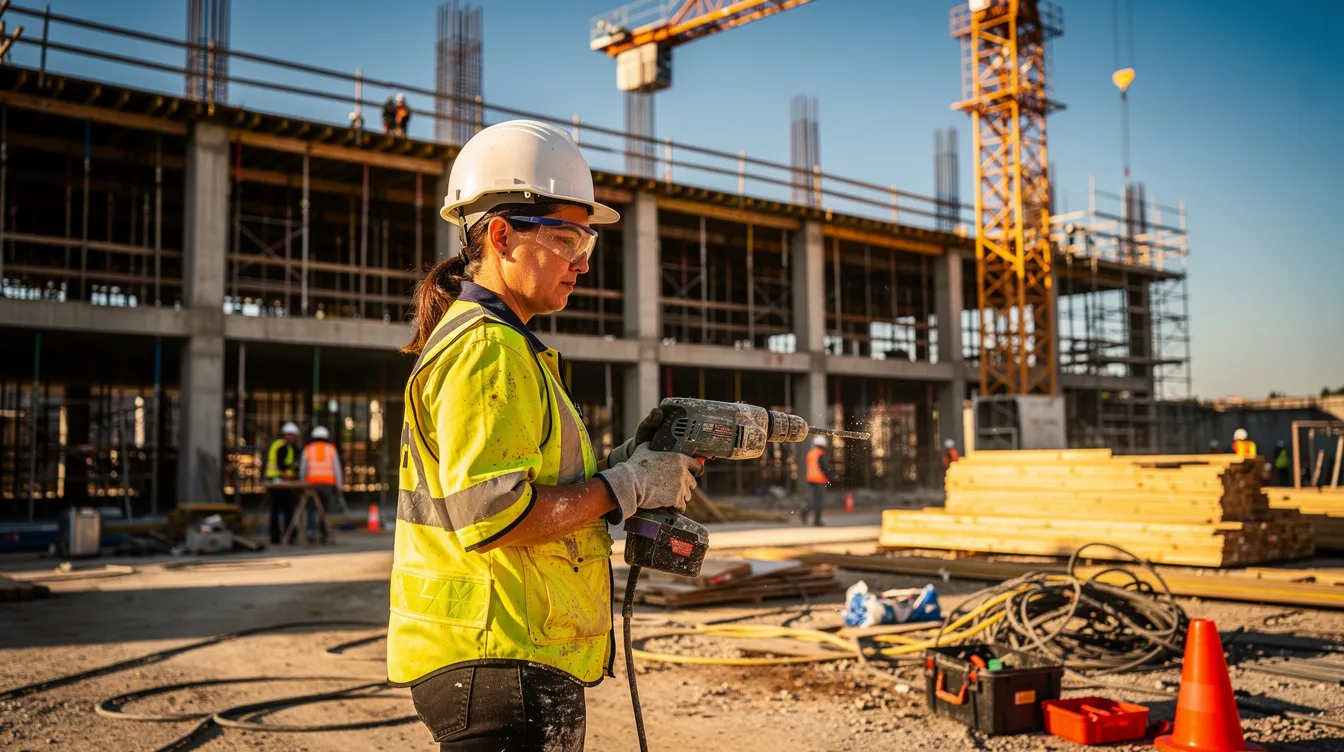
California’s construction boom is creating thousands of well-paid career opportunities—yet women remain vastly underrepresented on job sites across the state. With the right training, support, connections, and access to education and training, that’s changing. This guide is designed for women considering a career in construction, as well as educators, counselors, and employers interested in supporting gender diversity in the trades. This guide explores how women can enter the trades, what barriers exist, and how to overcome them, and how Trades For All is working to build a more inclusive construction workforce in Southern California by promoting education as a key component in supporting women in construction and advancing inclusion.
Key Takeaways
- Women constitute approximately 11% to 14.5% of the total U.S. construction workforce as of 2025-2026, but only about 4% work directly in the trades with tools in hand. California’s infrastructure and clean-energy investments are driving unprecedented demand for skilled workers.
- Trades For All, powered by ABC Southern California’s ERiCA grant, offers no-cost or low-cost pre-apprenticeship programs that help women enter construction careers without college debt.
- Journey-level wages in Southern California range from $30 to $50 per hour plus benefits—often significantly higher than female-dominated fields like retail or hospitality—and women can advance into leadership roles including foreperson, estimator, project manager, and contractor.
- This article covers current industry data, real barriers and solutions, pre-apprenticeship and apprenticeship details, and partnership opportunities for educators and employers committed to building inclusive crews, as well as education and training initiatives that empower women in construction.
- Concrete resources, upcoming events, and California-specific programs are included to help you take action immediately.
Women in Construction Today: Opportunities and Gaps
Women represent roughly 10% of the construction workforce nationally, with only 4% working in core trades such as carpentry, electrical work, plumbing, and heavy equipment operation. The construction workforce is increasingly viewing gender diversity as a strategic necessity rather than just a social goal—driven by labor shortages and the recognition that diverse teams deliver better outcomes.
Why demand is surging in California:
- The 2021 Bipartisan Infrastructure Law allocates over $1.2 trillion nationwide, including hundreds of billions for roads, bridges, ports, and water systems
- California’s $54 billion Climate Commitment is funding solar, EV charging, and grid modernization projects through 2030
- Housing mandates under SB 9 and AB 2011 target 2.5 million new units by 2030
Women of color remain especially underrepresented on job sites but now make up 15-20% of pre-apprenticeship applicants in Los Angeles, Orange, Riverside, and San Bernardino counties. Construction wages for journey-level workers in Southern California typically range from $30 to $50 per hour, plus benefits, totaling $62,000 to $104,000 annually. Compare that to retail ($18-22/hour), hospitality ($16-20/hour), or caregiving ($17-23/hour). These opportunities require no four-year degree, making construction a debt-free path to financial stability.

Our Vision for Women in Construction at Trades For All
Trades For All envisions women in California thriving across every construction role—from pre-apprentice to superintendent and business owner—while being visible, respected, and fairly compensated, and fostering a culture of inclusion throughout the construction industry. Women currently hold approximately 20% to 37% of leadership and management positions in the construction industry, and we aim to increase that share throughout our service region.
Our vision includes women as:
- Journey-level craftworkers in electrical, HVAC, carpentry, and more
- Forepersons and field supervisors leading crews
- Estimators, safety coordinators, and project controls specialists
- Construction management professionals and small business contractors
Women hold critical management roles in the construction industry, including project managers, engineers, and superintendents. We see women’s participation not just as a matter of fairness, but as an economic strategy. When women enter the trades, family income rises 20-30% above the median, children’s educational opportunities improve, and local communities grow stronger. Increased representation of women in construction is associated with improved safety compliance, enhanced problem-solving, and increased productivity.
Our Mission: Expanding Equitable Pathways into the Trades
Trades For All’s mission is to widen access to construction careers for women, veterans, and other underrepresented Californians through pre-apprenticeships, hands-on training, and direct connections to registered apprenticeships and employers.
Powered by ABC Southern California’s ERiCA grant from the U.S. Department of Labor, we focus on Southern California high schools, adult schools, community organizations, and reentry programs. The Women in Construction (WinC) program aims to equip women with essential skills for careers in construction, promoting financial independence and economic empowerment, while providing education and knowledge-sharing opportunities to support women’s advancement in the industry.
How we deliver on this mission:
- Classroom and shop-based training aligned with high-demand trades (electrical, low-voltage, HVAC, carpentry, heavy equipment)
- Women-in-trades info sessions featuring industry professionals and role models
- Job site tours with ABC Southern California member contractors
- Employer meet-and-greets highlighting women succeeding in the field
Labor market data from 2024-2026 shows 20,000+ annual openings in high-demand trades where women can start earning a living wage within their first year of apprenticeship. All programs emphasize equity, safety, and long-term career growth—not just short-term job placement.
Core Commitments and Beliefs About Women in the Trades
The following values shape every Trades For All construction program serving women, with a strong commitment to inclusion and diversity:
| Commitment | What It Means |
|---|---|
| Equal Pay | Women deserve equal compensation for equal work, with transparent promotion pathways |
| Access to High-Skill Roles | Women belong in welding, electrical, and heavy equipment—not only support roles |
| Economic Multiplier | Empowering women workers strengthens families, neighborhoods, and California’s economy |
| Safe Workplaces | Every job site must be free from harassment, retaliation, and gender discrimination |
| Voice in Leadership | Women should serve on safety committees, apprenticeship boards, and workforce planning groups |
| Diversity and inclusion in construction teams lead to innovative solutions, as different life experiences contribute to varied perspectives on problem-solving. We believe women’s participation makes all the difference for the industry’s future. |
Inclusive Pathways: Pre-Apprenticeship and Apprenticeship for Women
A pre-apprenticeship is a short-term training program that prepares participants for entry into a registered apprenticeship, which is a multi-year, paid training program leading to journey-level status in a skilled trade.
Here’s how a woman in California can move from curiosity about the skilled trades to a paid apprenticeship and journey-level card:
Pre-Apprenticeship (6-12 weeks):
- Education and hands-on training with basic hand and power tools
- Construction math and blueprint reading
- OSHA-10 safety certification
- Soft skills: communication, teamwork, professionalism
Many 2024-2026 pre-apprenticeship cohorts intentionally reserve seats for women and schedule classes to accommodate childcare and public transportation. Mentorship programs often include training sessions on essential skills such as communication and leadership, which are vital for women pursuing senior roles in construction.
What graduates earn:
- Industry-recognized certificates (OSHA-10, CPR/First Aid, NCCER Core)
- Credentials to present when applying to registered apprenticeships
Apprenticeship (3-5 years):
- Paid on-the-job training (starting at 40% of journey wage, scaling to 100%)
- 2,000+ OJT hours and 144+ classroom hours annually
- Portable journey-level card upon completion—no student debt

Breaking Barriers: Real Challenges and Practical Supports
Women face real barriers to entering construction. Many women report having to work harder to earn respect in the construction industry, which contributes to feelings of isolation. But solutions exist:
Childcare: About 60% of tradeswomen are parents. Programs like WinC have been recognized as best-practice models for combining workforce training with supportive services such as childcare and transportation stipends, thereby enhancing women’s participation in construction.
Transportation: Southern California’s sprawl can add 1-2 hours to commutes. Some programs provide transit passes, carpool networks, or locate training near major bus and rail routes.
Workplace Culture: Women frequently report experiencing or witnessing sexual harassment and gender-based bias in construction. Trades For All partners enforce anti-harassment policies, bystander training, and require visible female leadership on job sites. Ill-fitting personal protective equipment (PPE) poses safety risks and causes discomfort for women in the construction industry—leaders are increasingly addressing this concern.
Information Gaps: Many counselors still steer girls toward “pink-collar” jobs. Organizations that implement diversity training programs often experience significant increases in the hiring of underrepresented groups, such as a 40% increase in women hired for project management roles at Turner Construction.
Trades For All works with community-based organizations to provide wraparound supports, including financial coaching, tool stipends, and work boots for the first day on the job.
Mentorship, Community, and Role Models
Women who enter construction are far more likely to stay and advance when connected to mentors and peer networks. Support networks and mentorship programs are crucial for increasing women’s retention and success in construction.
Organizations like the National Association of Women in Construction (NAWIC) provide mentoring programs and support networks for women in the construction industry. Mentorship in construction plays a crucial role in helping women navigate challenging workplace situations, build confidence, and expand their professional networks.
How mentorship works at Trades For All:
- Alumni and experienced tradeswomen serve as guest speakers, lab assistants, and job site tour leaders
- Formal mentorship includes assigned mentors and scheduled check-ins
- Informal networking happens through WhatsApp groups and text communities
Effective mentorship can significantly improve retention rates for women in construction by providing direct support and guidance, helping them see a clear career path.
Success stories:
- A 2023 electrician apprentice now works on a Kaiser hospital project, earning $35/hour
- A former hospitality worker transitioned into carpentry in 2024 and doubled her income to $48/hour
Women in Construction (WIC) Week, celebrated annually, focuses on supporting and advancing women in the construction industry through a range of events and resources. Fort Worth and other cities host a construction conference and panel discussions during WIC Week that connect women working in trades with future opportunities.
How Educators, Counselors, and Employers Can Partner with Trades For All
Building a diverse workforce requires collaboration across K-12 schools, adult schools, community colleges, workforce boards, and construction companies.
For educators and counselors:
- Integrate construction careers into career days and CTE classes
- Invite Trades For All to present women-in-trades panels
- Host parent nights that normalize trades for daughters
For employers:
- Host job site tours for pre-apprenticeship cohorts
- Guarantee interviews for program graduates
- Co-design training modules reflecting real job requirements
Companies with diverse workforces can see a 25% boost in productivity and perform better financially, highlighting the importance of diversity in business outcomes. Construction companies that have more women in executive roles are significantly more likely to achieve above-average profitability.
Employers who intentionally recruit, retain, and promote women often see better safety outcomes, stronger problem-solving on crews, and improved reputation with public and private clients. Connect with Trades For All to create the foundation for your next generation of skilled workers.
Getting Started: Steps Women in California Can Take Right Now
You don’t need prior experience—only willingness to learn, show up on time, and work safely.
First steps:
- Contact Trades For All through our website or partner schools
- Attend a local information session or women-focused career fair
- Brush up on basic math (fractions, measurements)
- Gather documents: state ID, work authorization, high school diploma or equivalent
- Arrange childcare and transportation where possible
How to evaluate programs:
- Look for hands-on training focus
- Check employer ties (aim for 80%+ placement rates)
- Ask about their track record placing women into apprenticeships
Share this information with daughters, nieces, students, and friends. Construction isn’t a last resort—it’s a first-choice career path that builds California’s future and creates real innovation in how we construct our world.

Frequently Asked Questions
Do I need prior construction experience to join a pre-apprenticeship?
No prior experience is required. About 90% of participants start as complete beginners. Pre-apprenticeship training covers tool use, safety protocols, and job site basics from the ground up. Your willingness to learn matters more than any employee history in the trades.
Can I work in construction if I am balancing childcare or other caregiving duties?
Many women in the trades are parents or caregivers. While challenges exist, some programs offer flexible scheduling, early shift options, or connections to county and nonprofit childcare resources. Extra hours may be required during busy periods, but many companies now accommodate family responsibilities better than in the past.
What kinds of construction jobs are most accessible to women starting out?
Electrical, low-voltage, HVAC, carpentry, concrete, and equipment operation all have strong demand in California. The best fit depends on your interests, physical comfort, and local job availability. Engineering-adjacent roles like estimating and project controls also offer growth paths for those interested in office-based work.
How long does it take to become a journey-level craftworker?
Most registered apprenticeships in California last 3-5 years. During this time, apprentices receive increasing wages and responsibilities, with completion leading to journey-level status recognized across the industry. This is comparable to earning a college degree—but you’re getting paid from day one.
Is construction a safe career choice for women?
Construction carries physical risks for all workers, but modern safety standards, OSHA training, and employer accountability greatly reduce hazards. Research shows that women-led job sites often have 20% fewer safety incidents. You should expect the same quality, safety training, PPE, and respect as any person on site. Join a program that prioritizes safety culture and you’ll advance with confidence.